
Festival
Durga Ashtami
दुर्गा अष्टमी
Shukla paksha Ashtami of Ashvina.
Durga Ashtami dates
- 2026
- Monday, 19 October 2026
- 2027
- Thursday, 7 October 2027
Dates for Delhi. A tithi can begin and end at different times in different places, so a festival can fall a day apart; the panchang for your city shows the tithi day by day.
About Durga Ashtami
Durga Ashtami, or Maha Ashtami, is the eighth day of Sharad Navratri, the Ashtami of the bright fortnight of Ashvina, in September or October. Mahagauri is worshipped, many families perform Kanya Puja and a havan, and in Bengal the day brings the morning pushpanjali, Kumari Puja and, at the junction of Ashtami and Navami, the Sandhi Puja.
Significance
The Devi Mahatmya tells how on this part of her war the Goddess brought forth Chamunda to slay Chanda, Munda and Raktabija. Ashtami is therefore one of the most powerful days of Navratri, and honouring young girls as living forms of Devi expresses the belief that the Mother is present in every girl.
Puja vidhi
Durga Ashtami Kanya Pujan
The household worship of the Goddess on Maha Ashtami, with the Ashtami havan and Kanya Puja. Some families perform Kanya Puja on Navami instead; the steps are the same.
Durga Ashtami, Ashvina Shukla Ashtami, in the morning · About 90 minutes
- 1Bathe early and put on clean clothes. Many keep the Ashtami fast until the Kanya Puja is complete.
- 2Sip water three times (achamana) and take the sankalpa for the Ashtami worship. Worship Ganesha and the Navratri kalash.
- 3Worship the Goddess as Mahagauri, the form of the eighth day, with water, a red chunri, sindoor, kumkum, akshat, red and white flowers, a garland and the items of shringar.
- 4Offer incense and a ghee lamp. Recite the Durga Saptashati, or at least its eighth chapter, or the Durga Chalisa, and read or listen to the Durga Ashtami katha.
- 5If your family keeps the custom, perform a small havan, offering ghee and havan samagri while chanting "Om Aim Hreem Kleem Chamundayai Vichche Svaha".
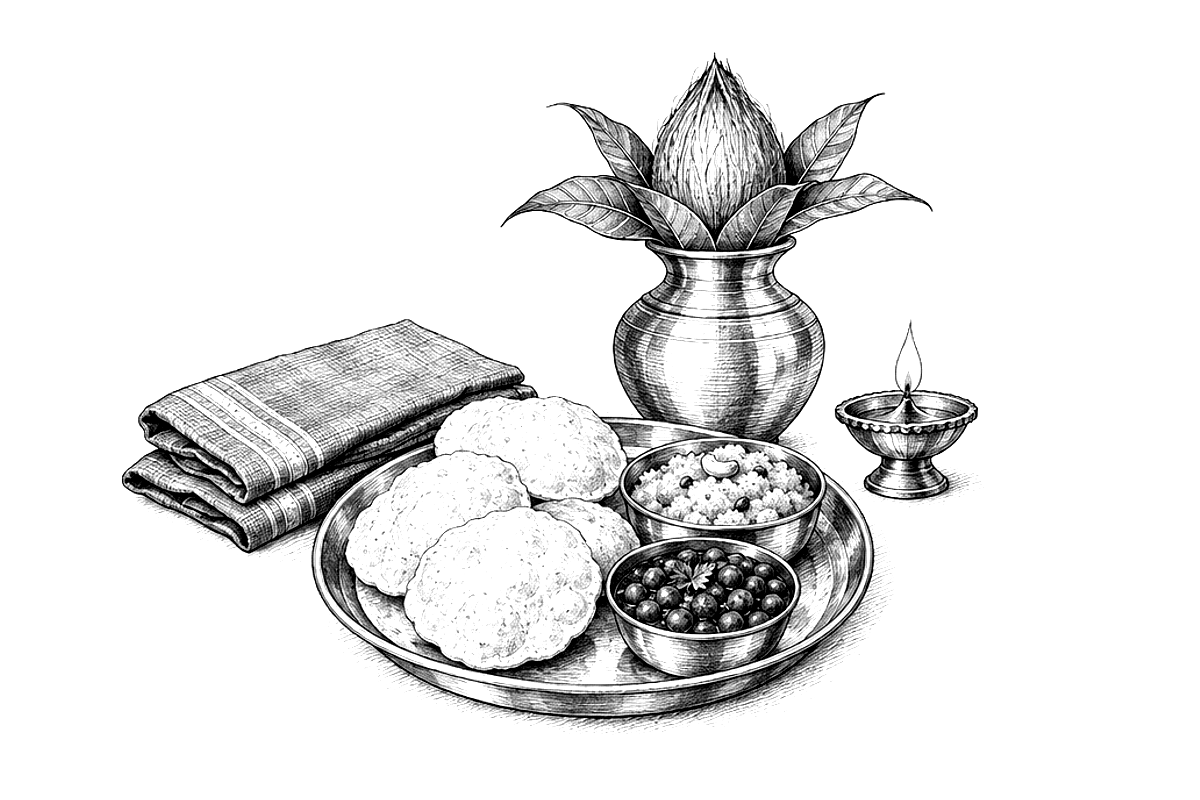
- 6Prepare the prasad: puri, black chana and sooji halwa, cooked fresh without onion or garlic.
- 7Invite young girls, traditionally nine, often between two and ten years old, and a little boy who is honoured as Bhairava or Langur.
- 8Welcome them at the door, wash their feet in a plate of water, dry them and seat them on a clean mat.
- 9Apply a tilak of kumkum and akshat, tie mauli on their wrists, and offer flowers or a chunri.
- 10Serve them the puri, chana and halwa with love, and let them eat their fill.
- 11Give each child a gift and dakshina: bangles, a small toy, fruit or money. Touch their feet and ask for their blessing as forms of the Goddess, and see them off with respect.
- 12Perform the aarti, "Jai Ganesh Deva" and then "Jai Ambe Gauri", ask forgiveness for any mistakes, and break the fast with the prasad.
- 13In Bengal and eastern India, follow the community worship: the Ashtami pushpanjali in the morning, Kumari Puja, and the Sandhi Puja with 108 lamps and 108 lotuses at the exact junction of Ashtami and Navami.
On the day the Goddess appeared as Chamunda to destroy what could not otherwise be destroyed, the household worships her in her fierce and gentle forms alike. Washing the feet of young girls and feeding them is a humble act of reverence that sees the Mother in every child.
Puja samagri
- Image of Durga and the Navratri kalash
- Red chunri and the items of shringar
- Roli, kumkum, sindoor and akshat (unbroken rice)
- Mauli (sacred red thread)
- Red and white flowers and a garland
- Ghee lamp, cotton wicks, incense and camphor
- Durga Saptashati or Durga Chalisa
- Havan kund, havan samagri, mango wood and ghee
- Puri, black chana and sooji halwa
- Plate of water and a cloth for washing the children's feet
- Gifts for the children: bangles, chunris, fruit or toys
- Dakshina for each child