
Festival
Jagannath Rath Yatra
जगन्नाथ रथ यात्रा
Shukla paksha Dwitiya of Ashadha.
Jagannath Rath Yatra dates
- 2026
- Thursday, 16 July 2026
- 2027
- Monday, 5 July 2027
Dates for Delhi. A tithi can begin and end at different times in different places, so a festival can fall a day apart; the panchang for your city shows the tithi day by day.
About Jagannath Rath Yatra
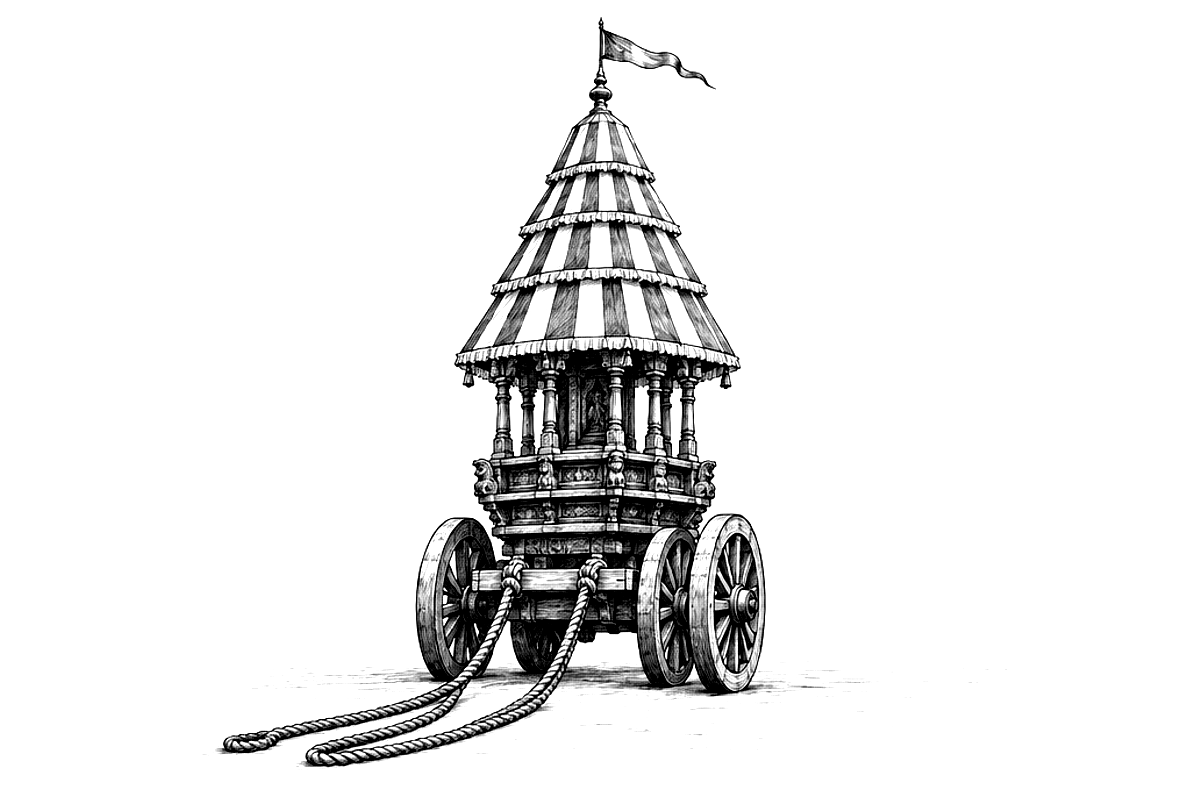
Jagannath Rath Yatra falls on Ashadha Shukla Dwitiya, the second day of the bright half of Ashadha. In Puri, Jagannatha, Balabhadra and Subhadra are brought out of the temple and pulled on three huge wooden chariots to the Gundicha temple, where they stay for about a week before the return journey, the Bahuda Yatra. Temples and devotees around the world hold their own chariot processions, and at home families worship the three deities and pull small chariots.
Significance
On this day the Lord leaves his sanctum and comes into the street, so that everyone, whatever their birth or station, can see him and pull his chariot. Tradition holds that a glimpse of Jagannatha on the chariot, and a hand on its ropes, frees one from the cycle of rebirth; the king sweeping the chariots shows that before the Lord all are servants.
Puja vidhi
Jagannath Rath Yatra Home Puja
A household worship of Jagannatha, Balabhadra and Subhadra on Rath Yatra day, with a small chariot procession at home or joining a local Rath Yatra.
Jagannath Rath Yatra, Ashadha Shukla Dwitiya, morning · About 60 minutes
- 1Bathe in the morning and wear clean clothes. Clean the shrine and decorate it with flowers.
- 2Place images of the three deities on a platform in their temple order: from left to right as you face them, Balabhadra, Subhadra and Jagannatha.
- 3Sip water three times (achamana) and take the sankalpa, stating your name, the date and place, and your prayer.
- 4Remember Ganesha with a flower and akshat, chanting "Om Gam Ganapataye Namah".
- 5Offer water, chandan, flowers and a garland to each deity, and tulsi leaves to Jagannatha.
- 6Light a ghee lamp and incense sticks.
- 7Offer naivedya with tulsi: khichdi or sweet rice, malpua or khaja, and fruits. Many Odia families make poda pitha for this season.
- 8Recite the Jagannathashtakam, or chant "Jai Jagannath" with folded hands.
- 9Decorate a small wooden or cardboard chariot, place the deities (or a picture) on it, and pull it slowly around the home, courtyard or lane, singing kirtan with kartal or bells. Children traditionally lead.
- 10If a Rath Yatra is held nearby, join the procession and take a turn pulling the ropes. Sweeping the path ahead of the chariot is a humble service, remembering the king's Chhera Pahanra in Puri.
- 11Return the deities to the shrine and perform the aarti with the lamp while singing "Om Jai Jagdish Hare".
- 12Listen to the katha of Jagannatha, then share the prasad with family and neighbours.
- 13About nine days later, on the Bahuda Yatra (Ashadha Shukla Dashami), offer a lamp and prasad again to welcome the deities home.
Pulling the Lord's chariot, even a small one at home, joins the household to the great procession in Puri, where the Lord comes out to meet all his devotees. The worship asks for his darshan and his embrace, open to everyone without distinction.
Puja samagri
- Images or a picture of Jagannatha, Balabhadra and Subhadra
- Small decorated chariot (optional)
- Flowers and garlands
- Tulsi leaves
- Chandan (sandalwood paste) and akshat
- Ghee lamp, incense sticks and camphor
- Khichdi or sweet rice
- Malpua, khaja or poda pitha
- Fresh fruits
- Conch, bell and kartal for kirtan
- A plate (thali) for the aarti