
Festival
Vasant Panchami
वसन्त पञ्चमी
Shukla paksha Panchami of Magha.
Vasant Panchami dates
- 2026
- Friday, 23 January 2026
- 2027
- Thursday, 11 February 2027
Dates for Delhi. A tithi can begin and end at different times in different places, so a festival can fall a day apart; the panchang for your city shows the tithi day by day.
About Vasant Panchami
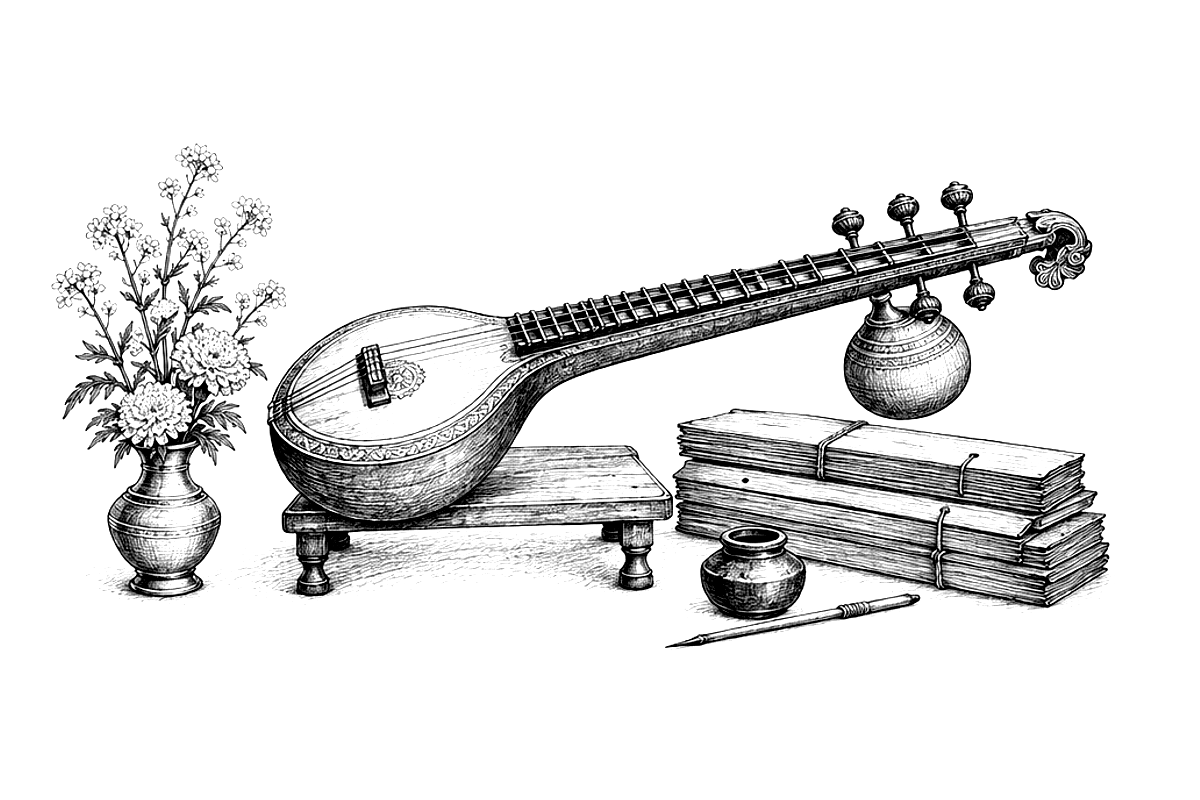
Vasant Panchami falls on the Panchami (fifth day) of the bright fortnight of Magha, in late January or February, and Saraswati is worshipped in the forenoon (purvahna). Families wear yellow, place books, pens and musical instruments before the goddess, and many children write their first letters on this day; in Bengal and Odisha it is kept as Saraswati Puja in homes, schools and colleges.
Significance
The day honours Saraswati, goddess of learning, speech, music and the arts, who tradition says appeared on this day to give voice to a silent creation. It also welcomes Vasanta, spring, when the mustard fields turn yellow, and is counted as one of the most auspicious days of the year to begin learning or any new work.
Puja vidhi
Vasant Panchami Saraswati Puja
The household worship of Saraswati on Vasant Panchami, done in the forenoon while Panchami tithi is current, together with the worship of books and instruments and, for young children, the first writing of letters (vidyarambha).
Vasant Panchami, Magha Shukla Panchami, in the forenoon · About 60 minutes
- 1Bathe in the morning and wear yellow or white clothes. Clean the place of worship.
- 2Set up a chowki facing east or north, cover it with a yellow or white cloth, and place an image of Saraswati on it, with a small image of Ganesha.
- 3Arrange books, notebooks, pens and musical instruments in front of the goddess. In many homes these are not used again until after the puja, or until the next day.
- 4Sip water three times (achamana) and take the sankalpa: state your name, the date and place, and your prayer for wisdom and learning for the family.
- 5Worship Ganesha first with water, roli, akshat, flowers and durva grass, chanting "Om Gam Ganapataye Namah".
- 6Invite Saraswati and offer water to wash her feet and to sip, a few drops of water as a bath, a yellow or white cloth, white sandalwood paste, akshat coloured with turmeric, and white or yellow flowers such as marigold, jasmine or mustard blossoms.
- 7Offer incense and a ghee lamp, then naivedya: yellow sweets such as kesar halwa, boondi or sweet saffron rice, fruits and, especially in Bengal, ber (Indian jujube).
- 8Chant "Om Aim Saraswatyai Namah" 108 times, or recite the Saraswati Vandana "Ya Kundendu Tushara Hara Dhavala" if you know it.
- 9Worship the books, pens and instruments with roli, akshat and a flower, asking the goddess to dwell in them.
- 10For a young child beginning to learn, let an elder hold the child's hand and help them write "Om" or the first letters of the alphabet on a slate, or with a finger in rice spread on a plate.
- 11Perform the aarti with a ghee lamp, first "Jai Ganesh Deva" and then "Jai Saraswati Mata", and read or listen to the Vasant Panchami katha.
- 12Offer flowers with folded hands (pushpanjali), as students do together in Bengal, and ask forgiveness for any mistakes in the worship.
- 13Share the prasad. Where the image is of clay, as in Bengal, it is immersed in water the next day after a short puja.
Ganesha is worshipped first so that learning proceeds without obstacles; Saraswati is then asked to make the mind clear, the speech truthful and the hand skilled. Worshipping one's books and instruments is a way of treating knowledge itself as sacred.
Puja samagri
- Chowki with a yellow or white cloth
- Image of Saraswati and a small image of Ganesha
- Books, notebooks, pens and musical instruments
- White sandalwood paste, roli and turmeric
- Akshat (unbroken rice), some coloured yellow with turmeric
- White and yellow flowers, mustard blossoms or marigold, and a garland
- Durva grass for Ganesha
- Ghee lamp, cotton wicks, incense and camphor
- Yellow sweets: kesar halwa, boondi or sweet saffron rice
- Fresh fruits and ber (Indian jujube)
- Slate and chalk, or a plate of rice, for a child's first letters
- Bell, and a plate (thali) for the aarti
Aartis and kathas
All festivalsPanchang for February 2027Every aarti and katha